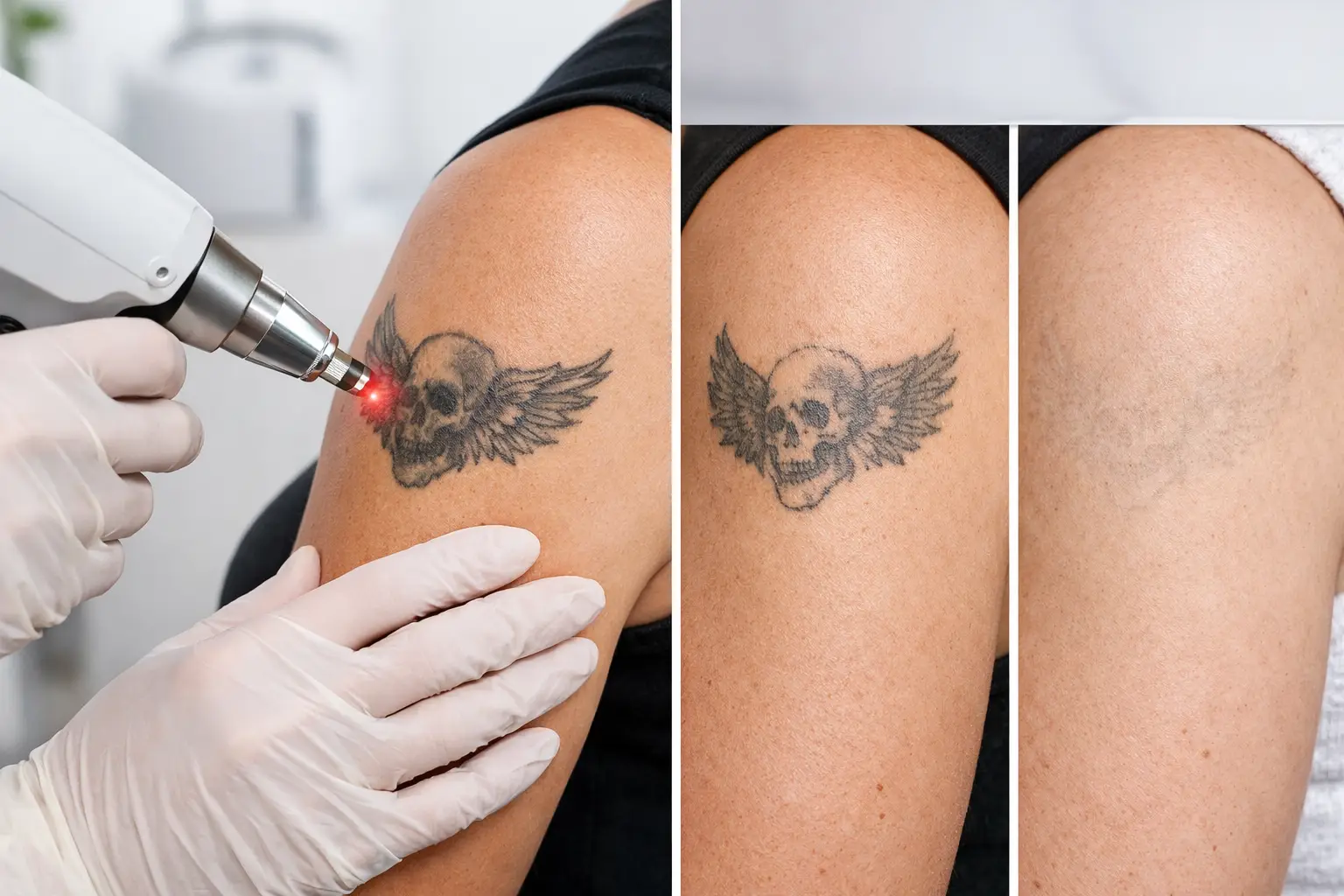
A tattoo can look very different after a few laser sessions, but the most useful laser tattoo fading examples are the honest ones: gradual changes in density, broken-up outlines and patches of lighter ink rather than a tattoo disappearing overnight. Seeing realistic progress helps you plan treatment with confidence and understand why your result may follow its own timeline.
What laser tattoo fading looks like in practice
Laser tattoo removal works by directing short pulses of light energy into tattoo pigment. The pigment absorbs that energy and breaks into smaller particles, which your body then clears gradually. That clearance happens between appointments, not just in the treatment room.
For many clients, the first visible sign is a softened, less solid appearance. Dense black areas may begin to look grey or slightly mottled. Fine lines can lose their sharpness, and a dark tattoo may appear less prominent from a normal viewing distance. These are encouraging changes, even when the tattoo is still clearly visible up close.
Progress is rarely perfectly even. One section may fade quickly while another holds colour longer. This is especially common in tattoos with multiple layers, differing line weights or a mix of professional and older ink. A tailored treatment plan accounts for those variations rather than promising that every part will respond at the same speed.
Example: A small black linework tattoo
A simple black outline, such as a small symbol or name, is often one of the clearer laser tattoo fading examples. After early sessions, the lines may look lighter and less crisp. With further treatment, sections can fragment into faint grey marks before gradually clearing.
Black ink generally responds well because it absorbs a broad range of laser wavelengths. However, “small” does not automatically mean “quick”. A tattoo on the ankle, foot or lower leg may take longer to clear than a similar design on an area with stronger circulation, such as the upper arm.
Example: A dense black-and-grey professional tattoo
A professionally applied tattoo often contains a substantial amount of ink placed evenly and deeply in the skin. In the beginning, shaded areas may fade before the darkest outlines do. A portrait or heavily shaded design can therefore look patchy during the process, with lighter areas appearing around stubborn dark details.
That patchiness is not necessarily a problem. It can be evidence that the pigment is breaking down at different rates. Patience matters here, because chasing fast results with treatments too close together does not give the skin and immune system enough time to do their work.
Example: An older tattoo with soft, faded edges
Older tattoos may already have some natural fading from sun exposure, skin changes and time. Laser treatment can build on that, but the result still depends on the ink used and how deeply it was placed. Some aged black tattoos respond very well, while others contain stubborn pigment despite looking pale.
The clearest change may be that a once-blue-black design becomes lighter grey and easier to cover with a new tattoo. Complete removal is one goal, but fading for a cover-up can be a practical and satisfying outcome when the original design no longer suits you.
Example: A colourful tattoo
Colour tattoos need a more individual assessment. Colours such as dark blue and some greens may respond differently from black, while lighter shades can be more unpredictable. Yellow, white, flesh-toned and certain red pigments may be particularly challenging, and some cosmetic pigments can darken before they begin to fade.
This does not mean coloured tattoos cannot be treated. It means a consultation should include a clear discussion about the specific colours present, potential response and the possibility that a small residual trace may remain. Honest expectations are part of safe, effective care.
Why two people can have very different results
Before-and-after images are useful for illustrating the treatment process, but they are not a guarantee. The same laser, applied to two tattoos of similar size, can produce different fading because the tattoos and the people wearing them are different.
Ink colour and density are major factors, as are the tattoo’s age, depth and whether it has been covered or reworked. Multiple tattoo layers usually require more treatment than a single design. The location matters too. Areas closer to the heart often have stronger circulation and may clear pigment more efficiently than hands, feet and lower legs.
Your skin type, health, immune response and aftercare also play a role. Avoiding unnecessary sun exposure, following wound-care instructions and allowing appropriate time between sessions support the process. Your practitioner will advise on the best interval for your skin and tattoo, rather than applying a one-size-fits-all schedule.
What happens between fading sessions
Immediately after laser treatment, the skin may look white or frosted for a short time. Redness, warmth, tenderness and mild swelling can follow. Depending on the treatment and your skin’s response, small blisters or crusting can occur. These reactions should be managed with the aftercare advice provided by your clinic.
In the following weeks, the tattoo may not look dramatically different every day. This can feel frustrating, particularly if you are eager to move on from a tattoo with difficult memories. Yet the quieter period between treatments is when your body is processing fragmented pigment.
Taking consistent photos before each session can be more helpful than checking the tattoo constantly in the mirror. Use similar lighting, distance and angle where possible. Comparing images over several appointments often reveals changes that are easy to miss day to day.
Fading for a cover-up versus full removal
Not every client needs complete removal. If your goal is a cover-up, reducing the darkness and visual weight of an existing tattoo may give your tattoo artist far more flexibility. The new design may be lighter, more detailed or better matched to your current style once the underlying ink has faded sufficiently.
A cover-up plan should be discussed early. Your laser practitioner can assess how much fading is likely to be needed, while your tattoo artist can advise on the level of clearance required for the design you have in mind. Starting with a clear goal can prevent unnecessary sessions, although the tattoo’s response may still alter the plan along the way.
For full removal, the aim is to reduce visible pigment as much as possible while protecting the health of the surrounding skin. Some tattoos can clear extremely well. Others may leave a faint shadow, altered pigment or a trace of resistant ink. A professional consultation should make room for both possibilities.
When to seek advice during treatment
Laser tattoo removal should be carried out by trained practitioners using appropriate technology and protocols. Your skin should be assessed before treatment, particularly if you have a history of keloid scarring, pigment changes, allergies or a medical condition that may affect healing.
After treatment, contact your clinic if discomfort is increasing rather than settling, if you notice signs of infection, or if you are uncertain about how your skin is healing. Do not pick crusting or pop blisters. Protect the area from sun exposure and follow the aftercare directions given specifically for you.
At Coastal Skin Clinic, tattoo removal consultations are designed to give you a realistic view of what may be possible for your tattoo, your skin and your end goal. The most reassuring laser tattoo fading examples are not the fastest ones – they are the ones achieved steadily, safely and with a plan that respects your skin.