
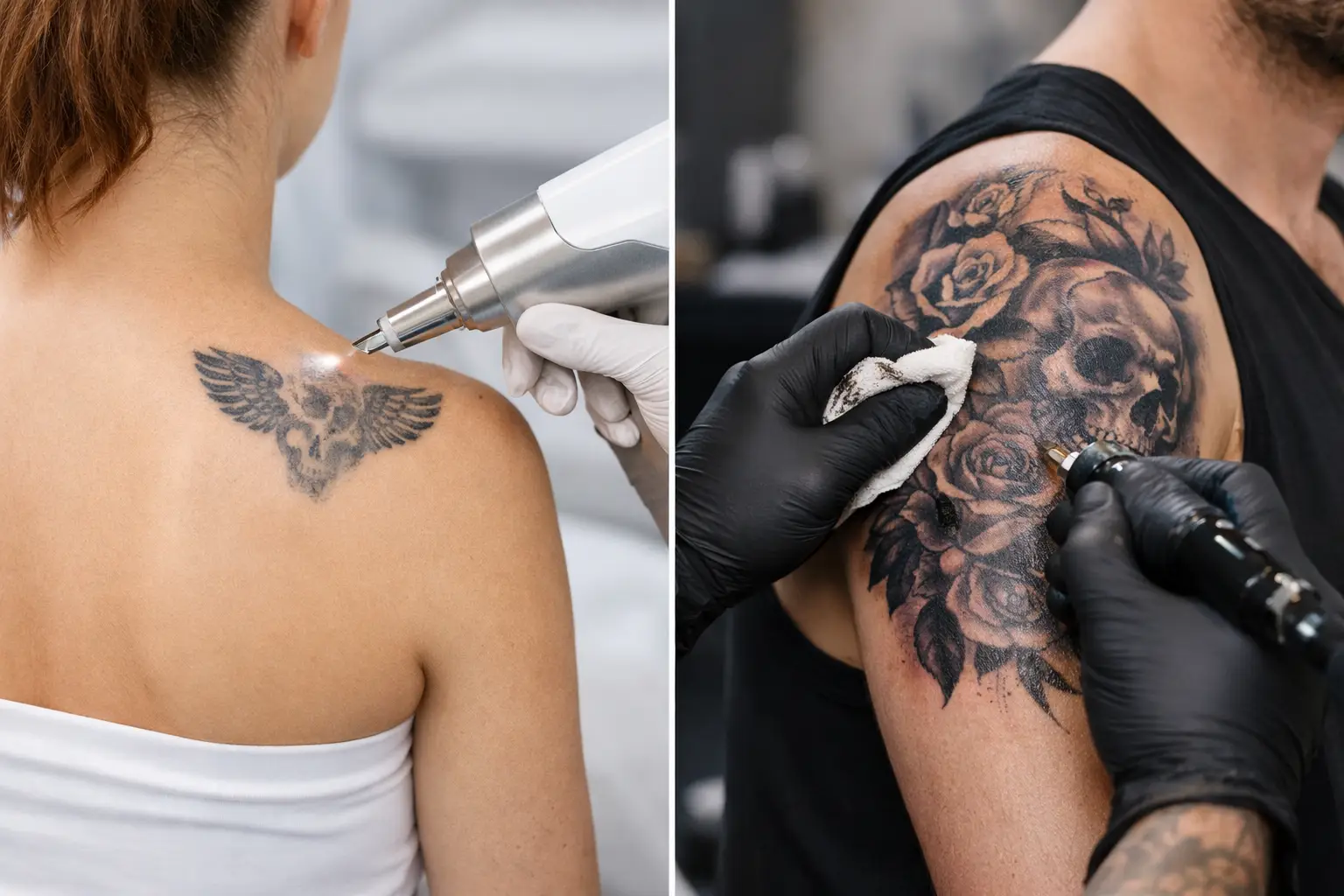
That moment usually happens quietly – you look at an old tattoo and realise it no longer fits who you are. If you are weighing up laser tattoo removal vs cover up, the right choice depends on what you want to see on your skin in six months, not just next week.
Some people want a clean slate. Others still love tattoos but not that particular design. Both options can be valid, but they solve different problems. A cover up replaces one tattoo with another. Laser removal lightens or clears existing ink so you have more freedom, whether your end goal is bare skin or a better tattoo later on.
Laser tattoo removal vs cover up: what is the real difference?
The biggest difference is simple. A cover up hides the existing tattoo under a new design, while laser tattoo removal works to break down the old pigment so the body can gradually clear it.
That sounds straightforward, but the decision is rarely just about technique. It is also about how much of the old tattoo is still visible, how dark and dense the ink is, where it sits on the body, and whether you genuinely want another tattoo in that area.
A cover up can be a great choice when you still want body art and you are open to a larger, darker or more detailed design. Laser removal tends to suit people who want to erase a tattoo completely, significantly fade it, or create a better base for a more refined cover up.
When a cover up makes sense
A cover up can work well if the existing tattoo is already quite faded, small, or made up of lines that a new artist can cleverly absorb into a fresh design. In those cases, the result can look intentional and beautiful rather than like a patch job.
It is often the faster option in the short term. If you are not attached to the idea of clear skin and you are happy to commit to a new design, a skilled tattoo artist may be able to transform the area without months of laser sessions.
But there are trade-offs. Cover ups are rarely small and delicate. The new tattoo usually needs to be bigger, darker and more complex to effectively mask what is underneath. That can limit your design choices. If you were hoping for something light, minimalist or fine-line, an untouched cover up may not give you enough freedom.
There is also the long-term question. If you already regret one tattoo, it is worth pausing before placing another over the top. A cover up can solve the visual problem, but only if you truly want a new tattoo there.
When laser removal is the better option
Laser removal is often the better fit when your goal is flexibility. By fading the original tattoo, you are not forcing the next step. You can continue with more sessions toward full removal, or you can stop once the ink is light enough for a cover up with better design options.
This is especially helpful with dense black ink, old amateur work, names, heavy shading, or tattoos that sit in visible areas where you want a cleaner result. Fading first can give a tattoo artist far more room to work with. Instead of trying to bury a strong old design, they can create something more balanced and natural-looking.
For many clients, laser is also the more emotionally comfortable path. It gives you time to think. Rather than making a quick decision to hide something you dislike, you can gradually reduce it and decide what feels right as the tattoo changes.
Why fading before a cover up often gives a better result
This is where many people get caught out. They assume the choice is removal or cover up, when in reality the strongest option is often both.
A few laser sessions can dramatically soften the old tattoo. That means the new tattoo artist does not need to rely on extra darkness, heavy packing, or oversized design elements to conceal what was there before. You may end up with a cover up that looks cleaner, less bulky and more true to the style you actually want.
If your current tattoo is very dark, highly saturated, or has awkward placement, trying to cover it without any fading can be restrictive. Laser can reduce that pressure. It does not always mean removing the whole tattoo. Sometimes partial fading is enough to improve the final result.
What about pain, healing and commitment?
People often ask which hurts more. The honest answer is that both can be uncomfortable, but in different ways.
Laser tattoo removal is usually quick per session, although you will need multiple visits spaced over time. The sensation is often described as sharp and hot, but the treatment itself is relatively fast. Healing usually involves temporary redness, sensitivity and care instructions to protect the area.
A cover up tattoo can involve longer chair time depending on the size and detail of the new piece. If the artist needs to heavily saturate the skin to conceal the existing design, that session can be demanding too. Then there is the usual tattoo healing process afterwards.
The bigger difference is commitment. A cover up is one major decision. Laser removal is a series of decisions over time. Some people prefer the speed of one new tattoo. Others prefer the control that comes with gradual fading.
Cost matters, but so does outcome
It is natural to compare costs, but short-term cost and long-term value are not the same thing.
A cover up may seem more affordable upfront because it can be done in fewer appointments. But if the result still feels compromised, too dark, or not quite what you wanted, you may end up frustrated and facing laser later anyway.
Laser removal usually requires more patience and an ongoing treatment plan, so the investment can be spread over time. What many people value, though, is the freedom it creates. You are paying for options – clearer skin, a better future cover up, or the ability to stop once the tattoo reaches a point you are happy with.
A proper consultation is the best place to weigh this up because the size, colours, age and location of the tattoo all affect what is realistic.
Not all tattoos respond the same way
This is where expert guidance matters. Some tattoos are straightforward to fade. Others are more stubborn.
Black ink often responds well to laser treatment, while certain colours can be more variable. Professional tattoos may contain more concentrated ink than amateur ones. Newer tattoos can behave differently from older faded pieces. Areas with better circulation may also respond differently over time.
The same goes for cover ups. A tiny script tattoo on the wrist presents a different challenge from a large, dark shoulder piece. There is no one-size-fits-all answer, which is why tailored advice matters more than generic online before and after promises.
How to decide what is right for you
Start with one question: do you want another tattoo there?
If the answer is clearly yes, a cover up may be worth exploring. If the answer is no, laser removal is usually the more obvious path. If the answer is maybe, fading first often makes the most sense because it keeps your options open.
It also helps to think practically. Ask yourself whether you are comfortable with a larger or darker design, whether you want the freedom to go lighter and finer, and whether your current tattoo has enough visible ink that it will dominate any cover up attempt.
For many people, the best outcome comes from not rushing. A professional assessment can help you understand whether full removal, partial fading, or a direct cover up is most likely to give you a result you will still feel good about later.
The value of a professional consultation
When clients come in asking about laser tattoo removal vs cover up, they are rarely just asking about ink. They are asking for clarity, reassurance and a plan that suits their skin, their tattoo and their goals.
That is why an in-person consultation matters. A trained practitioner can assess the ink density, placement, skin condition and likely response to treatment, then talk through what is realistic. In some cases, the answer will be laser. In others, it may be a referral back to a trusted tattoo artist after partial fading. The key is choosing the option that serves you, not the one that simply sounds quickest.
If you are in the Sunshine Coast area and feeling unsure, the most useful next step is not guessing. It is having someone experienced look at the tattoo properly and explain your real options. A good plan should leave you feeling informed, supported and confident about what comes next.